Across Africa, while progress is being made in school enrollment, millions of young people continue to be left behind by education systems designed around a linear pathway. The assumption has long been that learners must adapt to formal schooling, standardized assessments, and traditional credentials. And for young people navigating financial hardships, caregiving responsibilities, health challenges, or unstable livelihoods, the linear pathway is simply out of reach. Yet the demand to learn has never disappeared.
This edition examined how alternative learning pathways can expand access, restore opportunity, and better align education systems with the realities of today’s learners and labour markets, especially Out-of-School Youth (OOSY), who remain excluded from traditional systems while seeking opportunities to learn and thrive. Grounded in lessons from the Resilience in Secondary Education (RISE) initiative by the Mastercard Foundation in Rwanda, the conversation assessed what it takes to move alternative learning from fragmented interventions into credible, scalable systems.
The Future of Learning Is Flexibility
Opening the discussion was Rwanda’s Minister of Education, Joseph Nsengimana, who optimistically mentioned that two pathways can exist and still achieve the same goal – a more educated population.
“I see it as we’re going to move from a very structured system to offering a multitude of alternative pathways to learning and a mix of the two as we look at education for the future,” he said. Referencing systems like the GED in countries such as the United States, Canada, and the United Kingdom, he explained that formal and alternative pathways can successfully coexist without undermining one another. “The introduction of AI, machine learning, and new technologies are getting us closer to the possibility of truly individualized learning,” he added.
This flexibility is becoming increasingly important in Africa, where education systems are expanding but not always evolving quickly enough to prepare learners for changing labour markets that value adaptability, digital fluency, and practical competencies.
Ivan Ntwali, Country Director at the Mastercard Foundation in Rwanda, highlighted that millions of young Africans remain locked out of education and economic opportunity despite clear evidence linking education investments to improved livelihoods and social outcomes. “We have tens of millions of young people across Africa that are out of school, and they’re locked out of better jobs and trapped in cycles of poverty,” he said.
And for Ntwali, governments and stakeholders do not need to wait for perfect evidence before acting. “There’s enough evidence that calls us to act,” he emphasized. “We can start small while strongly monitoring enrollment, attendance, retention, and learning gains.”
The RISE initiative in Rwanda, currently with an enrollment of 10,000 learners, already offers an example of this approach in practice, using flexible and technology-enabled learning models to help out-of-school youth return to education while balancing everyday responsibilities.
Designing Learning Around Learners
At Carnegie Mellon University (CMU), learning specialists supporting the RISE initiative explained how the learning management system was intentionally designed for learners who may have been out of school for years. “RISE is all about removing barriers,” explained Erin Czerwinski, Manager, Learning Engineering and Technology Enhanced Learning Product, at CMU.
Designed with accessibility and flexibility in mind, the program enables mobile-friendly learning, flexible pacing, real-time progress tracking, targeted feedback, and facilitator support to help learners navigate their education journeys more effectively.
“We are finding that these learners are very motivated and excited to jump into the learning,” she said. “We stay very responsive to whatever is needed in the field.” The technology is also open-source and locally grounded, with infrastructure hosted within Rwanda to reduce connectivity barriers and improve accessibility.
From Access to Recognition: Making Alternative Learning Work at Scale
Another major theme was the importance of government ownership and policy alignment. Too often, alternative education programs across Africa operate as isolated pilot projects, lacking long-term sustainability and official government recognition.
To formally recognize alternative credentials, the Government of Rwanda revised its national qualification framework and established equivalency recognition for learners who complete programs such as RISE. “We had to modify our qualification framework to make sure that we actually recognize an equivalent secondary education certificate,” said Minister Nsengimana.
Charles Avelino, Chief Education Officer at UNICEF Rwanda, explained that one of the biggest challenges was ensuring accelerated learning pathways still maintained credibility and alignment with national and global standards. “How do you deliver six years of secondary education in the shortest possible period while still allowing young people to progress to university or employment?” he asked.
According to Avelino, sustainable reform cannot happen through parallel systems alone. “What is really important is alignment,” he noted. “For any system that benefits participants in the best possible way, you need full alignment with government systems.”
The Human Side of Alternative Learning
Beyond policy and technology, the discussion highlighted the lived realities of young people who had dropped out of school due to financial hardship, illness, and family challenges. For many learners, alternative pathways became more than a route back to education; they represented restored dignity, confidence, and renewed hope for the future.
“I couldn’t get a good job because most jobs require secondary school qualifications,” shared Kelia Manzi Rutayisire, a 29-year-old who dropped out of school in 2016 and is now back in school through the RISE program. “You also lose self-confidence because you feel like others are advancing while you are left behind.”
Another learner, 24-year-old Socrates Sangano Mukiza, who dropped out in 2021 and is now back to learning with the RISE program, described how financial constraints and illness disrupted his education journey. “When I was trying to get jobs, I didn’t have the diplomas or certificates needed,” he shared. “That is why I wanted to return to school through this opportunity.”
Their stories reinforced a central message from the discussion: young people still want to learn. What often fails them is not motivation, but systems that are too inflexible to accommodate their realities.
As the conversation concluded, one message was clear: the future of education in Africa cannot remain tied to a single pathway. Alternative learning pathways are increasingly becoming essential components of resilient, inclusive, and future-ready education systems.
To scale effectively, government and stakeholders must invest in flexible and competency-based learning models, formally recognize alternative credentials, build accessible digital infrastructure, and support systems that reflect the realities of learners while connecting education pathways to employment and continued learning opportunities.
Most importantly, systems must evolve from asking whether learners can fit into education systems to asking whether education systems are flexible enough to support learners. Across Africa, millions of young people are still ready to learn. The question is whether education systems are ready to meet them where they are.
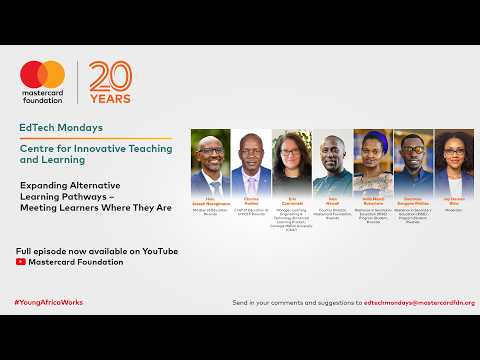
Expanding Alternative Learning Pathways
Panelists:
- Hon. Joseph Nsengimana, Minister of Education, Rwanda
- Ivan Ntwali, Country Director, Mastercard Foundation, Rwanda
- Erin Czerwinski, Manager, Learning Engineering & Technology-Enhanced Learning Product, Carnegie Mellon University
- Charles Avelino, Chief Education Officer, UNICEF Rwanda
- Rutayisire Manzi Kelia, Student, Resilience in Secondary Education (RISE), Rwanda
- Mukiza Sangano Socrates, Student, Resilience in Secondary Education (RISE), Rwanda
EdTech Mondays Africa
The Centre for Innovative Teaching and Learning runs EdTech Mondays, which raises awareness and facilitates discussions on harnessing the power of technology in teaching and learning to improve the relevance and quality of education across Africa.